Although the Shapton GlassStone HR stones are a good choice for sharpening, they can be used as a high-quality surface. The Shapton GlassStones is one of the best sharpening surfaces you can find.
The Shapton GlassStone HR is their finest range for hard steels and modern steel alloys. Among the best stones you can find on the market. Made with high precision and featuring consistent ceramic abrasives that ensure an even and quick sharpening process. Each stone has a glass backing which makes it flat and stable. These stones measure about 8 1/4 inches long, 2 3/4 inches wide, and 3/8 inches thick (210mm x 70mm x 10.5mm), and they are made in Japan.
Why They’re Great
Fast Cutting and Long-Lasting: Shapton GlassStones are fast cutters and do not wear out as quickly as conventional Waterstones. Consequently, they require less flattening over time and reduce the amount of abrasive material that is thrown away.
Glass Backing: Although the glass backing on these stones is only 5mm thick, it’s enough to ensure their stability and evenness. Furthermore, this means that you may use the stone until almost nothing remains instead of other stones which break when they are thinning.
Consistent Abrasive Particles: The abrasive particles on Shapton stones are very uniform in size. This feature enables them achieve faster cutting speeds and gives a better finish. On the other hand, uneven sharpening can result from inconsistent particles thereby leading to a rougher edge.
Size: Every Shapton GlassStone measures 210mm x 70mm x 10.5mm. With this size, most tools can be sharpened easily along with knives.
What Is a GlassStone?
The word “GlassStone” does not mean that it is made of glass stone itself. The actual section for honing on the stone is white ceramic while the glass only serves as a backing to provide flatness and stability to it. At the bottom of each stone however, there is an indication of its grit level which can be seen through the glass enabling immediate identification.
No Soaking Required
Shapton stones do not require any soaking unlike the traditional water-stones. Just sprinkle some water on it and you’re good to go. They do not absorb water, so a spray bottle is ideal for this.
Grit Options in HR Series
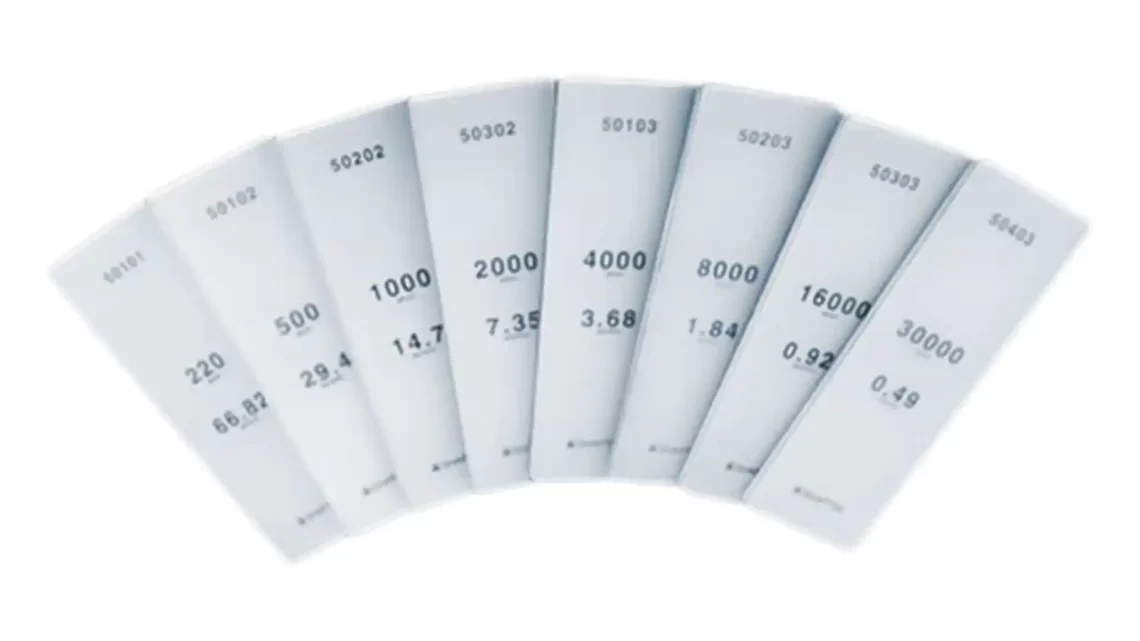
For different sharpening needs, the HR Series stones have differing grits as highlighted below:
120 Grit: Very coarse, for very dull tools and knives. Highly accelerated cutting due to large sized grit particles (122.5 microns).
220 Grit: Coarse, for very dull tools and knives. Large sized grit particles (66.82 microns).
320 Grit: Coarse, for very dull tools and knives. Large sized grit particles (45.94 microns).
500 Grit: Medium coarse, good for dull tools and knives that balances fast cutting with less rough finish (29.4 microns).
500 Grit Double-Thick: Same as 500 grit but thicker hence lasting longer; can be used when creating a new edge, often on flat ground chisels (29.4 microns).
1000 Grit: Medium grit refines edges after initial sharpening (14.7 microns)
2000 Grit: Medium fine further refines edges (7.35 microns)
3000 Grit: Fine-for a smoother edge on already refined tools-4-9-micron-sized-grains
Fine finishing stone 4000 Grit: (3.68 microns – very fine).
Super fine finishing stone 6000 Grit: (2.45 microns – near mirror polish).
Ultra-fine finishing stone 8000 Grit: (1.84 microns – near mirror polish).
Finisher’s final polishing stone 10,000 Grit: (1.47 microns – almost mirror polish).
Final polishing stone 16,000 Grit: (0.92 microns – true mirror polish)).
Pre-polishing Stone 30,000 Grit: (0.49 microns) – The finest grit available.
Frequently Asked Questions About Shapton Glass Stones
Are Shapton Glass Stones made entirely of glass?
No. The sharpening stone itself is made from premium ceramic abrasive. The glass layer on the back simply acts as a rigid backing plate, providing strength and stability while sharpening.
Which Shapton Glass Stones are available?
The Shapton GlassStone HR (High Resistance) series is available in a wide range of grits, from 120 grit for heavy edge repair all the way up to 30,000 grit for ultra-fine polishing.
Should I use a lapping plate?
Yes. Like all water stones, Shapton Glass Stones gradually wear with use and should be flattened periodically. A Shapton Diamond Glass Lapping Plate or DMT Dia-Flat Lapping Plate is recommended, especially for maintaining coarse grit stones.
Is a stone holder necessary?
While not required, a sharpening stone holder is highly recommended. A holder prevents the stone from slipping during sharpening, making the process safer and more comfortable. Shapton’s own stone holder works well, but many universal sharpening stone holders are also suitable.
What does “HR” stand for?
HR stands for High Resistance. These stones are specifically engineered to sharpen today’s wear-resistant steels and high-hardness blades while maintaining excellent cutting performance and durability.
What’s the difference between the HR and HC series?
The HR (High Resistance) series features white-colored stones designed for modern stainless steels, powdered steels, and other high-alloy knife steels. The HC (High Carbon) series is gray in color and is optimized for traditional high-carbon steels. HC stones are commonly selected for the final stages of sharpening and polishing.
Where are Shapton Glass Stones manufactured?
All Shapton Glass Stones are proudly manufactured in Japan, where Shapton maintains strict quality control standards to ensure consistent performance. Jende Industries is an authorized Shapton dealer, offering genuine Japanese-made Shapton sharpening stones.