For the past 14 years, I’ve had the honor of conducting the National Sun Yat-Sen University (中山大學) wind band club in Taiwan. Established in 1980, this university ranks among the top 10 in Taiwan and boasts a comprehensive music department. Remarkably, our wind band club comprises students from diverse academic backgrounds, none of whom major in music. Over the years, we’ve achieved notable success, clinching 2nd place in the National Southern Taiwan Band Competition, receiving a “Highest Achievement” award from the Ministry of Education, and even performing at the University’s graduation ceremony. Needless to say, I couldn’t be prouder of their accomplishments.
This year marks a significant milestone for our band. Dr. Sun Yat Sen (1866-1925), known by his Chinese nickname 中山 (Chung Shan), which translates to “middle mountain” (originally called “Nakayama” in Japanese), played a pivotal role in advocating democracy in pre-communist China and later in democratic Taiwan. He remains a highly revered figure in both nations. In 1924, he founded a civic university that would later become Chung Shan University in Guangzhou, China. This year commemorates the 90th anniversary of the school’s establishment. As part of the celebrations, students from the band, choir, and string club of our Taiwanese University were invited to participate in a collaborative concert.
Although the timing coincided with midterms for our Taiwanese students, we rallied approximately 35 club members for the trip. As their band conductor, I joined the journey, albeit remaining in the background. This event was about fostering China-Taiwan relations, not about my role as a conductor. My presence aimed to ensure that my students made the most of this experience. Unlike music majors, these students hadn’t experienced regional or all-state bands. I anticipated that the hours of rehearsals spanning several days would pose a challenge, yet the rewards would be invaluable.
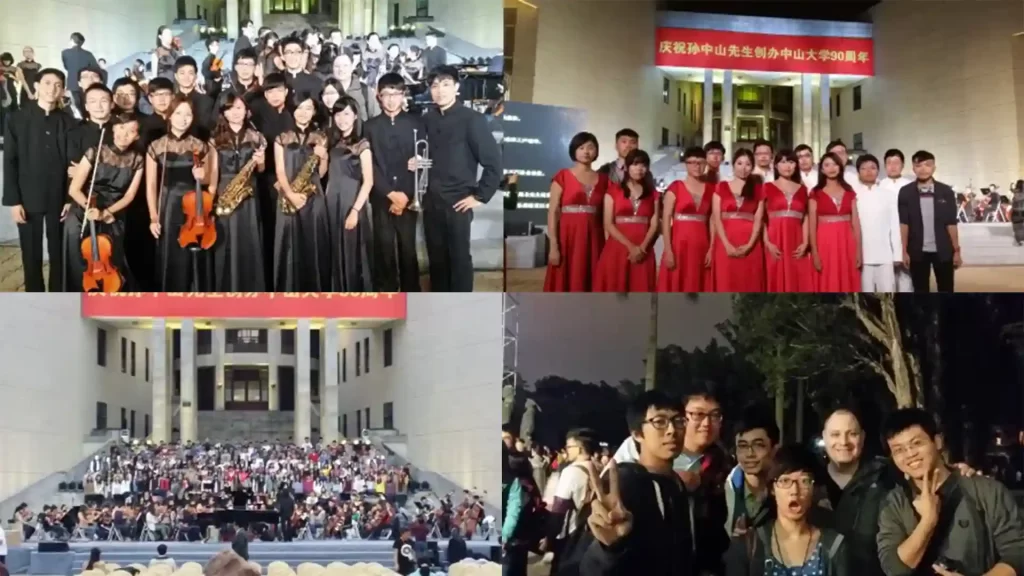
The journey commenced with enthusiasm as we arrived at Chung Shan University in China, an experience that felt familiar yet distinct. Our students, unfamiliar with each other, found their places in the first rehearsal, adapting to the new environment. While the joint choirs were not yet present, our students maximized their free time by rehearsing independently.
Days of intense rehearsals and sleep deprivation took their toll on the students, but it was time for a venue check, sound check, and dress rehearsal.
Finally, the concert arrived and concluded in a flurry. We captured moments of our groups together – the band, string clubs, and choir, along with our fantastic support team.
For my students, this journey proved transformative. They experienced performing in a grand orchestra alongside a choir, enduring relentless hours of rehearsal under exceptional conductors. Just when physical exhaustion seemed overwhelming, the excitement of the concert propelled them through an extraordinary performance experience they’ll long remember after graduation. Their achievement was commendable, not just musically but also on a personal growth level. They forged friendships with individuals who, politically, were considered adversaries. Through the unifying power of music, they discovered the shared humanity between students of sister schools, transcending perceived differences.